
Quick Answer: On the secondary market in 2026, refurbished full-size C-Arm machines commonly range from the low five figures for proven older platforms — think GE OEC 9800-era systems with image intensifiers — up to six figures for late-model flat-detector systems such as the GE OEC Elite CFD, Siemens Cios line, or Ziehm flat-panel units. Refurbished mini C-Arms for extremity work typically cost less than full-size systems, while brand-new full-size C-Arms from the OEM run well into six figures once software, monitors, and installation are included. The biggest price dividers are detector technology (image intensifier vs. flat panel), system age, tube condition, and software packages. Buying refurbished typically saves facilities 30–70% compared to new equipment, which is why the refurbished route remains the default choice for surgery centers, orthopedic practices, and pain management clinics.
What Is a C-Arm Machine and Who Uses One?
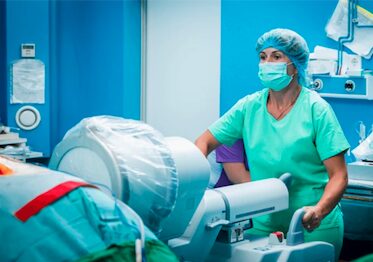
A C-Arm is a mobile fluoroscopy system — a real-time X-ray machine named for the C-shaped arm that connects its X-ray tube on one end and its detector on the other. Because the arm rotates and slides around the patient, clinicians can capture live images from almost any angle without repositioning the person on the table. That flexibility is why the C-Arm machine has become standard equipment across so many specialties.
The core use cases you’ll see on quote requests every week include:
- Orthopedic surgery: fracture reduction, hardware placement, spinal instrumentation, and joint procedures where the surgeon needs live confirmation of implant position.
- Pain management: fluoroscopy-guided injections — epidurals, facet blocks, nerve ablations — where needle placement accuracy is everything.
- General and vascular surgery: catheter navigation, stent placement, and angiography runs that demand vascular software packages and higher heat capacity.
- Urology: stone procedures, stent placements, and retrograde studies, often paired with a specialized urology table.
- Cardiac and electrophysiology support in hospital settings, typically on higher-end flat-detector systems.
The buyer profile matters because it drives the spec. A pain clinic doing injections has very different requirements — and a very different budget — than a hospital running vascular cases. Matching the machine to the procedure mix is the single most important step in getting the price right, and it’s where a specialist conversation saves buyers real money.
Full-Size vs. Mini C-Arm: Which One Fits Your Facility?
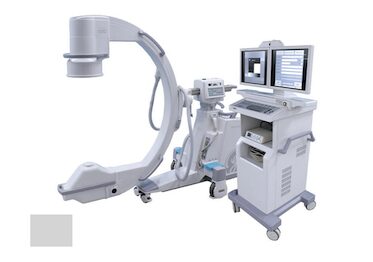
The first fork in the road is size. Full-size C-Arms are the workhorses of surgery centers and hospital ORs: powerful generators, large fields of view, and the penetration to image the spine, hips, abdomen, and vasculature. Mini C-Arms are compact, lower-dose systems built for extremities — hands, wrists, elbows, feet, and ankles — and they’ve become fixtures in orthopedic offices, hand surgery practices, and podiatry clinics.
| Factor | Full-Size C-Arm | Mini C-Arm |
|---|---|---|
| Typical anatomy | Spine, hips, abdomen, chest, vasculature, extremities | Extremities only (hand, wrist, elbow, foot, ankle, knee in some cases) |
| Typical settings | Hospital ORs, surgery centers, pain clinics, cath lab support | Orthopedic offices, hand surgery, podiatry, urgent care, sports medicine |
| Generator power | High-output; penetrates dense anatomy and larger patients | Low-power; lower radiation dose, often no lead-lined room required (verify with your physicist) |
| Footprint | Larger; usually paired with a separate workstation cart and monitors | Compact single unit that rolls between exam rooms |
| Representative models | GE OEC 9800, OEC 9900 Elite, OEC Elite CFD, Siemens Cios, Philips Zenition, Ziehm Vision | OrthoScan FD, OrthoScan Mobile DI, GE OEC mini platforms |
| Refurbished price band (hedged) | Commonly low five figures to six figures depending on generation | Typically less than comparable full-size systems; often low-to-mid five figures |
The rule of thumb: if your procedure list includes anything torso-related — spine, hips, vascular, urology — you need a full-size system. If you exclusively image extremities in an office setting, a mini C-Arm delivers the images you need at a lower purchase price, lower dose, and smaller footprint. Some busy orthopedic groups end up with both: a full-size unit in the surgery center and a mini in the clinic.
Image Intensifier vs. Flat Panel Detector: The Biggest Price Divider
If you remember one technical distinction from this guide, make it this one. The detector — the component that converts X-rays into an image — comes in two generations, and it splits the entire C-Arm market into two price universes.
Image Intensifier (II) Systems
Image intensifiers are the classic analog-style detector: a vacuum-tube assembly that amplifies the X-ray signal onto a camera. II systems dominated the market for decades, and platforms like the GE OEC 9800 and 9900 Elite proved so reliable that thousands remain in daily clinical service. IIs come in sizes — commonly 9-inch and 12-inch — with the larger size preferred for vascular and bariatric work. On the secondary market, II-based C-Arms are the value play: mature, well-understood, widely serviceable, and priced accordingly.
Flat Panel Detector (FPD) Systems
Flat panel detectors are the digital successor: a solid-state panel that produces sharper, distortion-free images with a square field of view, better dose efficiency, and no vacuum tube to degrade over time. Every current-generation C-Arm — GE OEC Elite CFD, Siemens Cios Alpha and Fusion, Philips Zenition, Ziehm Vision RFD — is flat-panel. The image quality difference is real, especially for vascular and complex spine work. So is the price difference: flat-detector systems commonly command two to four times the price of comparable II systems on the refurbished market.
For many buyers — especially pain management and general orthopedic practices — a well-refurbished II system delivers everything the caseload requires at a fraction of flat-panel cost. Facilities running vascular cases, complex deformity work, or high daily volumes are the ones who most often justify the flat-detector premium. Our C-Arm pricing guide goes deeper on how detector generation shapes the quote.
C-Arm Machine Price Ranges by Tier
C-Arm pricing is quote-driven, and configuration differences make generic numbers unreliable — but bounded ranges help you budget. The tiers below reflect typical secondary-market patterns in 2026. Specific pricing and availability vary based on location, equipment selection, and current market conditions, so treat these as planning figures, not offers.
| Tier | What It Is | Representative Systems | Typical Refurbished Range (Hedged) |
|---|---|---|---|
| Level 1 — Proven II platforms | Older-generation full-size systems with image intensifiers; workhorses for ortho and pain management | GE OEC 9800, Philips BV Pulsera (earlier), Siemens Arcadis (earlier) | Commonly low five figures — often the most affordable path into a full-size C-Arm |
| Level 2 — Late-model II systems | Newer image-intensifier systems with upgraded workstations, more software, better availability of parts and options | GE OEC 9900 Elite, Siemens Arcadis Avantic, Philips BV Pulsera (later) | Typically mid five figures, rising with 12″ IIs and vascular packages |
| Level 3 — Flat-detector systems | Current-generation digital flat-panel C-Arms with premium image quality and dose efficiency | GE OEC Elite CFD, Siemens Cios Alpha/Fusion, Philips Zenition, Ziehm Vision RFD | Commonly high five figures into six figures refurbished, depending on age and software |
| Mini C-Arms | Compact extremity imaging systems for office and clinic use | OrthoScan FD, OrthoScan Mobile DI, GE OEC mini platforms | Typically less than full-size systems; often low-to-mid five figures refurbished |
| New full-size (reference) | Factory-new flat-detector systems purchased from the OEM | Current OEC, Cios, Zenition, Ziehm lines | Well into six figures once software, monitors, and installation are included |
Two takeaways. First, the jump from Level 2 to Level 3 is the largest price step in the market — that’s the II-to-flat-panel divide at work. Second, within each tier, condition and configuration move quotes significantly: a Level 1 system with a fresh tube and a vascular package can approach Level 2 money, while a bare-bones late-model II can dip toward Level 1. A custom quote always makes sense — a generic number rarely reflects what your specific configuration will cost.
The Models That Define the Market: GE OEC, Siemens, Philips, Ziehm, OrthoScan
The GE OEC Line: The Market Benchmark
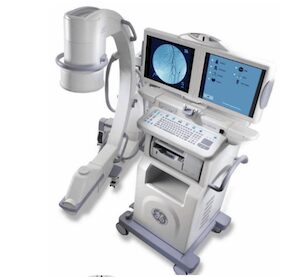
No conversation about C-Arm prices gets far without the GE OEC family, because OEC systems are the de facto benchmark of the secondary market. The GE OEC 9800 is arguably the most successful mobile C-Arm ever built — a platform so widely deployed and so well-supported by third-party parts and service that it remains a rational purchase decades after launch. For pain management and general orthopedics, a properly refurbished 9800 is often the best value per imaging dollar in the entire modality.
The OEC 9900 Elite is its successor: the same fundamental reliability with an updated workstation, flat-screen monitors, and refreshed electronics, positioned in our Level 2 tier. At the top sits the OEC Elite CFD, GE’s flat-detector generation, which competes in the premium tier with the newest European systems.
Siemens, Philips, Ziehm, and OrthoScan
Siemens covers the II generation with the Arcadis family and the flat-panel generation with the Cios line (Cios Fusion and Cios Alpha at the high end, popular for vascular and hybrid-style work). Philips brings the long-running BV Pulsera on the II side and the newer Zenition flat-panel series. Ziehm, a C-Arm specialist, is known for compact, motorized, and flat-detector Vision-series systems with strong vascular capability. On the mini side, OrthoScan effectively defines the category — if you’ve searched for a mini C-Arm for sale, you’ve seen OrthoScan FD and Mobile DI listings dominate the results.
All of these makes hold value on the secondary market. The practical guidance: pick the platform your service ecosystem supports. OEC’s ubiquity means parts and engineers are everywhere, which is a real total-cost advantage for independent facilities.
What Drives a C-Arm’s Price
Two C-Arms with the same model number can be quoted tens of thousands of dollars apart. Here’s what moves the number:
- Detector type and generation. The single biggest factor. Flat-panel detectors command a substantial premium over image intensifiers, and within FPD systems, newer detector revisions cost more.
- Image intensifier size. On II systems, a 12-inch intensifier costs meaningfully more than the standard 9-inch. Vascular, urology, and bariatric work usually justify the larger field of view; injection-focused pain practices usually don’t need it.
- X-ray tube condition. Tubes wear with use. A system with a recently replaced or low-use tube is worth more — and saves you a five-figure replacement down the road. Always ask for tube history on any used C-Arm cost comparison.
- Software packages. Vascular packages (subtraction angiography, roadmapping), expanded cine memory, measurement software, and DICOM connectivity options each add to the quote. Only pay for packages your procedures actually use.
- Workstation and monitors. Later workstation revisions, flat-screen or high-brightness monitor upgrades, and touchscreen interfaces all shift pricing within a model family.
- Overall condition and refurbishment depth. An as-is auction unit and a fully refurbished, calibrated, QA-tested system are different products at different prices — and different risks.
When you compare quotes, compare configurations line by line. The cheapest headline number often hides an aging tube, a 9-inch II where you needed 12, or missing software you’ll pay to add later.
Not sure which configuration your caseload actually requires? Request pricing from our team and a C-Arm specialist will walk through your procedure mix and match it to systems currently in inventory — usually a 15-minute conversation that prevents an expensive mismatch.
How to Buy a C-Arm: A Step-by-Step Walkthrough
Facilities that follow a defined process land better machines at better prices. Here’s the sequence we recommend:
- Define your procedure mix. List the cases the C-Arm will support over the next five years — not just today’s. Include patient population (bariatric volumes matter) and estimated weekly case counts.
- Choose full-size or mini. Any torso, spine, or vascular work means full-size. Extremities-only in an office setting points to a mini. This decision alone brackets your budget.
- Pick your detector generation. Decide whether an image-intensifier system covers your image-quality needs or whether flat-panel is justified by vascular work, complex spine cases, or volume. This is the biggest cost lever you control.
- Decide refurbished vs. new. For most surgery centers and practices, refurbished wins on value — 30–70% savings with warranty coverage. New makes sense mainly when an OEM relationship, specific new-only feature, or capital policy requires it.
- Request configured quotes. Get itemized quotes specifying detector, II size, tube status, software packages, monitors, and warranty terms — so you’re comparing like for like. Review the C-Arm buying FAQ before quote calls; it covers the questions that trip up first-time buyers.
- Plan delivery, installation, and training. Confirm who handles shipping, rigging (rarely an issue for mobile C-Arms, but doorways and elevators matter), physicist testing, state registration, and applications training. Amber supports the process from site planning to shipping, installation and technical servicing.
Budget four to eight weeks from first call to first case for most refurbished C-Arm purchases, depending on inventory, refurbishment queue, and your state’s registration requirements. If you’re evaluating multiple modalities at once, our imaging equipment buyer’s guides hub covers the same ground for MRI, CT, X-ray, and more.
Total Cost of Ownership: Beyond the Sticker Price
The purchase price is the headline, but smart buyers budget the whole picture. Plan for:
- Service coverage. Annual service contracts or time-and-materials coverage; C-Arms are mechanically simpler than MRI or CT, so coverage is comparatively affordable, but budget for it from day one.
- X-ray tube replacement. Tubes are consumables on a long fuse. Depending on usage, expect a replacement at some point in the system’s life — a five-figure event you can plan for rather than be surprised by.
- Image intensifier or detector health. IIs degrade slowly over years; flat panels can fail outright. Ask how each is tested and what the warranty covers.
- A C-Arm table. Frequently forgotten in first budgets. A radiolucent C-Arm table — pain management, urology, or general surgical — is a companion purchase for most new fluoro programs. Budget for it alongside the machine so it doesn’t surface as a surprise line item.
- Room readiness and compliance. Physicist survey, lead shielding assessment (full-size systems), state registration, dosimetry badges, and lead aprons.
- Applications training. Efficient techs shorten cases and cut dose. Confirm whether initial training is bundled.
None of these items should scare a buyer off — C-Arms are among the most affordable modalities to own and operate in medical imaging. The point is simply to compare total five-year cost, not sticker price alone, when weighing quotes.
Why Refurbished C-Arms Are the Sweet Spot
C-Arms may be the strongest refurbished value proposition in all of imaging, for three structural reasons.
First, the platforms are proven. Machines like the OEC 9800 and 9900 Elite were engineered for OR duty cycles and have demonstrated multi-decade service lives. A refurbished unit isn’t a gamble on an unknown design — it’s a known-quantity platform restored to specification.
Second, the parts and service ecosystem is deep. Because these systems sold in enormous numbers, tubes, image intensifiers, hand controls, and boards remain widely available, and independent service engineers know them cold. That keeps ownership costs low for the machine’s entire second life.
Third, the savings are substantial. Refurbished imaging equipment typically costs 30–70% less than new — and because C-Arm image quality on a well-maintained II system remains clinically excellent for orthopedic and pain applications, most buyers give up little that their caseload would ever notice. That’s how a surgery center keeps costs down and imaging capabilities high.
One more lever worth knowing: if you’re replacing an existing unit, you can sell or trade in your current C-Arm. Amber Diagnostics buys used C-Arms directly from hospitals, surgery centers, and practices nationwide — submit your equipment details, get a fair offer from an equipment specialist, and put the proceeds toward the upgrade.
How Amber Diagnostics Refurbishes and Tests C-Arms
Since 1994, Amber Diagnostics has bought, refurbished, and sold medical imaging equipment from our Orlando, Florida facility. Our refurbishment process is designed to transform imaging equipment back into like-new condition so it meets the manufacturer’s performance specifications before it ships.
For C-Arms, that process includes a multi-point inspection of the entire system — generator, tube, detector or image intensifier, collimator, mechanics, and workstation — followed by replacing and repairing worn parts, electrical refurbishment, cosmetic restoration, and final calibration. Every system undergoes QA testing, including phantom imaging, to verify image quality and dose performance before it’s approved for sale.
Just as important is what surrounds the machine: warranty coverage, financing options, and support from site planning to shipping, installation and technical servicing. With 30+ years on the secondary market, our team has handled thousands of installations and knows the practical details — power, doorway clearances, state registration timelines — that keep a project on schedule. Browse current refurbished C-Arm inventory to see what’s available now, or ask us to source a specific configuration.
C-Arm Pricing FAQ
How much does a C-Arm machine cost in 2026?
Refurbished full-size C-Arms commonly range from the low five figures for proven older image-intensifier platforms like the GE OEC 9800 to six figures for late-model flat-detector systems such as the OEC Elite CFD or Siemens Cios. Refurbished mini C-Arms typically cost less than full-size units, often landing in the low-to-mid five figures. New full-size systems from the OEM run well into six figures once software and installation are included. Final pricing depends on detector type, image intensifier size, tube condition, software packages, and overall condition, so a configured quote is the only reliable number for budgeting.
What is the difference between a used C-Arm cost and a refurbished C-Arm cost?
The difference is what’s been done to the machine. A “used” or as-is C-Arm is sold in whatever condition it left its last facility — unknown tube life, no calibration, usually no warranty — and is priced lowest for that reason. A refurbished C-Arm has been through inspection, parts replacement, electrical refurbishment, calibration, and QA testing, and ships with warranty coverage. Refurbished units cost more than as-is units but far less than new, and for most clinical buyers the warranty and verified performance are worth the difference. The 30–70% savings figure buyers hear about compares refurbished pricing to new OEM pricing.
Is the GE OEC 9800 still worth buying?
Yes, for the right caseload. The OEC 9800 remains one of the most widely supported C-Arms in the world, with deep parts availability and engineers who know it everywhere. For pain management, general orthopedics, and routine surgical fluoroscopy, a properly refurbished 9800 delivers clinically excellent images at one of the lowest entry prices in the modality. Facilities doing heavy vascular work or seeking flat-panel image quality should look at later platforms, but as a value purchase the 9800 has few rivals — which is exactly why it remains the benchmark of the secondary market.
How much does a mini C-Arm cost compared to a full-size system?
Mini C-Arms typically cost meaningfully less than full-size systems — refurbished units from makers like OrthoScan often land in the low-to-mid five figures, while new minis cost more but still undercut new full-size systems. The trade-off is scope: minis image extremities only. If your practice treats hands, wrists, feet, and ankles in an office setting, a mini delivers what you need at lower purchase price, lower dose, and a footprint that rolls between exam rooms. If your case list includes spine, hip, torso, or vascular anatomy, only a full-size C-Arm will do the job.
Should I buy an image intensifier or flat panel detector C-Arm?
Buy the detector your procedures require. Image-intensifier systems cost substantially less and remain clinically excellent for orthopedic hardware placement, fracture work, and fluoroscopy-guided injections — the bread and butter of most surgery centers and pain practices. Flat-panel systems deliver sharper, distortion-free images with better dose efficiency, and they earn their premium in vascular procedures, complex spine work, and high-volume ORs. Many facilities that assume they need flat-panel discover an II system covers their actual caseload; a specialist review of your procedure mix is the fastest way to find out before you spend the difference.
What else should I budget for besides the C-Arm itself?
Plan for a radiolucent C-Arm table (a companion purchase for most fluoro programs), annual service coverage, an eventual X-ray tube replacement over the system’s life, physicist testing and state registration, lead aprons and dosimetry, and applications training for your staff. None of these is individually large by imaging-equipment standards — C-Arms are among the most affordable modalities to own — but together they belong in your capital request so the project doesn’t stall on surprise line items after the machine arrives.
Related guides from Amber Diagnostics
- Sell My C-Arm: How Much Is a Used C-Arm Worth?
- CT Scan Machine Guide: Types, Slice Counts, and 2026 Prices
- Who Buys Used Medical Imaging Equipment?
Request C-Arm Pricing from Amber Diagnostics
Ready for real numbers instead of ranges? Tell us your procedure mix and budget, and a C-Arm specialist will match you with refurbished full-size and mini systems currently available — with itemized quotes covering warranty, delivery, installation, and training. Since 1994, Amber Diagnostics has helped hospitals, surgery centers, and practices keep their costs down and imaging capabilities high. With our experienced team and extensive resources, we promise to bring excellent support and reliable end-to-end service.
Request Pricing — or call us Toll Free at +1 888-561-7900 or direct at 407-438-7847. You can also email info@amberusa.com.
