
The Siemens Definition Dual Source 128 Slice CT Scanner produces images with high resolution and speed
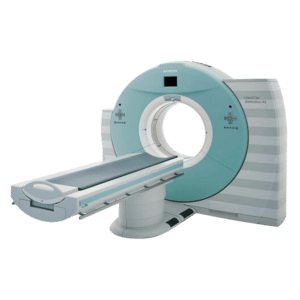
Siemens Definition Dual Source Overview
The Siemens Definition Dual Source 128 Slice CT Scanner produces images with twice the resolution and speed of the most advanced single-source CT systems, up to 128-slice CT scans, all without the need for a patient to take medications to slow the heart.
Benefits:
- Up to 128-slice CT scans
- Two X-ray tubes and an enhaced detector array
- Up to 50 percent less radiation exposure
- Faster than a heart beat
- The most advanced CT technology available
- Clear images without the use of beta blockers
Features:
Single-source
Functions as a conventional single-source 128-slice CT scanner for head or body imaging.
Single-source 4D spiral
Patient is moved smoothly in and out of the gantry to provide 14-cm z-axis coverage for perfusion imaging
Dual-source cardiac
Both sources operate at the same energy to provide high temporal resolution (85 msec)
Dual-source Flash
Both sources operating at the same energy at pitch values up to 3.4 and provide 85 msec temporal resolution
Dual-source dual-energy
The two sources operate at different energies to characterize or classify materials
Dual-source obese
The two sources operate at the same energy to maximize scanner output (2x100kW)
More Options
Related CT Scanners


Where the 128 slice number comes from on this scanner
This is not a 128-row detector. The SOMATOM Definition carries two measurement systems mounted at right angles on one gantry. Each one uses a 32 x 0.6 mm detector array, and each one uses double z-sampling, the flying focal spot technique Siemens calls z-Sharp, to read 64 overlapping projections along the z axis at every tube position. Two sources at 64 slices each is where 128 slices per rotation comes from.
That matters when you compare quotes. A single-source 128-slice scanner from another manufacturer may have a genuinely wider detector and cover more anatomy per rotation. This system trades detector width for time, and it buys you temporal resolution rather than coverage. Decide which one your case mix actually needs before you compare prices.
The two measurement systems do not see the same field of view
This is the single most useful thing to understand about the platform, and it rarely appears in a listing.
The primary tube and detector image a 50 cm field of view. The second tube and detector image a 26 cm field of view. Every mode that needs both systems working together, which includes dual-source cardiac, the high-pitch mode, dual-energy material characterization and the high-output mode for large patients, operates inside that smaller central field.
Practically, that means the scanner behaves as a conventional 64-slice system across the full 50 cm field, and as a dual-source system in the center. If you are buying it for dual-energy work or for cardiac, confirm with your radiologists that the anatomy you care about sits inside the 26 cm field at the positioning you use.
Two tubes means two tube histories
A single-source CT has one tube to track. This one has two, and they rarely wear evenly, because the second system is only loaded in dual-source modes.
Ask for the following per tube, not as a system total:
- Tube identity and serial number, and whether either tube is an original or a replacement.
- Scan seconds or exposure counts, with the date the reading was taken.
- Any record of arcing, thermal faults or repeated cooling delays in the error logs.
- The quoted replacement cost and lead time for the tube type fitted, from whoever will service the system.
A Definition with one fresh tube and one near end of life carries a tube replacement nobody has put in the price yet. Get both readings before you compare it with anything else.
Licenses and software that change what the scanner can do
The acquisition modes on this page depend on licensed software as much as on hardware. Verify each item on the configuration report for the serial number, not from the model name.
- Software release and syngo version on the console.
- Dual-energy applications, and which specific post-processing packages are licensed.
- Cardiac package and reconstruction options.
- Dose management features and dose structured reporting.
- DICOM services, worklist, storage commitment and the network configuration already in use.
- Whether every license transfers to a new owner on resale, in writing from the party that holds it.
Site and project review before you commit
A dual-source gantry is a heavy, power-hungry install with a service footprint to match. Confirm the delivery route, door openings and floor loading along the path and in the room; electrical supply, standby and peak loads, and chilled water or room cooling against the figures for this exact generation; shielding design with a qualified physicist for your planned workload; network, PACS and worklist integration against the software release actually installed; and who performs acceptance testing and which state registration steps apply at your address.
Then assign responsibility in the contract for deinstallation, rigging, transport, site work, installation, calibration, acceptance testing, applications training and documentation. Gaps between those lines are where used CT projects lose money.
What to settle in the written quote
- Serial numbers for the gantry, both tubes, both generators, the console and the table, plus the exact detector configuration.
- Which software licenses and clinical packages are included, and confirmation that they transfer.
- Which inspection, calibration and image quality records will be supplied, and their dates.
- Which logistics, installation, training, warranty and service items are included and which are excluded.
Ask for the configuration report and the service and preventive maintenance history up front. If the scanner has already been removed from clinical use, ask what can be demonstrated powered up before shipment and what has to wait until after installation. A clean gantry cover tells you nothing about the tubes behind it.
Frequently asked questions
Does “128 slice” fully describe this scanner? No. On this platform the number is two 64-slice measurement systems working together, built from two 32 x 0.6 mm detector arrays using double z-sampling. Slice labels across the used market mix detector geometry, reconstruction and marketing convention. Ask for the configuration report and compare the physical detector, the acquisition modes and the installed software before you compare one scanner with another.
What matters most when comparing two Definition units? Both tube histories first, then the installed software release and licensed packages, then the service and preventive maintenance records, then recent image quality and dose output results. Two scanners with the same model badge can be years apart in remaining useful life.
Should I buy this or a Definition Flash? They are different generations with different hardware. The Flash uses two 100 kW generators and acquires 128 slices per tube; Amber lists it in the 256 slice category. This platform uses two 80 kW generators and two 64-slice systems. If your decision depends on power reserve or high-pitch scan speed, tell Amber that up front so the comparison is made on specifications rather than on slice labels.
Ask for a configuration review on this model
Tell us the exam mix you plan to run, the destination address, your target install date and the project scope you need covered. Ask for both tube histories, the configuration report and the license list in writing. Name the Definition Dual-Source in your message, because the contact form does not currently carry the model across from this page.
Ask Amber Diagnostics about a Siemens Definition Dual Source CT scanner
