
The Esaote O-Scan extremity MRI Machine innovative design integrates a complete RF shielding in one unique structure
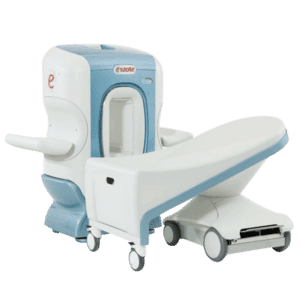
Esaote O-Scan Overview
The Esaote O-Scan Extremity MRI Machine takes account of the need for higher through-puts in Radiological settings and Orthopedic practices. It can easily work alongside whole body scanners in Radiology departments, freeing-up the time for major clinical cases therefore allowing you to improve your work flow and provide an optimal patient experience. In orthopaedic centers it can give direct access to MRI without having to make another appointment, saving both time and costs for the patient and the healthcare provider. With the O-scan, the faster track to MRI for extremities, you can break traditional barriers.
Benefits:
Power is not just about technical capacity, it is also a state of mind. O-scan changes your perspective on MRI and allows you stand out from the crowd making it a truly “empowering” experience for the user and patient.
Performance O-scan is result oriented and therefore fully customized to efficiently do its job, producing high quality musculoskeletal images with a high throughput.
Pride We all want to take pride in what we have and what we do and the O-scan allows you to do just that. A high tech MRI system, very nice Italian industrial design, unique patient comfort, high quality images; an Esaote extremity MRI with attributes valuable for both patients and users.
Partnership Esaote is the ideal partner in MRI, whatever your specialization, be it Radiology, Orthopedics, Sports Medicine. O-scan is in fact the result of over 15 years of experience working closely with customers.
Pace In today’s fast moving environment you need to keep up to speed technically as well as economically. With O-scan you choose the fasttrack for your high-tech diagnostic services and last but not least for return on investment.
Features:
- Open permanent magnet
- 0.31 Tesla field
- No RF Shielding Cage required
- Max RF power: 1500 W
- Shimming: passive
- Gradient: ±20 mT/m
- Slew rate: 50 mT/m/ms
- FOV: 14 cm
- Very compact, installation space of 9 m2 required
- Low Power Consumption: only 1 kW in normal 220/110V power outlet
- Complete set of dedicated DPA coils
More Options
Related MRI Machines
What a dedicated extremity scanner is for
The O-scan is built for limbs. Esaote supplies it with dedicated DPA coils for the knee, the hand and wrist, and the foot, ankle and elbow. It is not a small whole-body MRI. You cannot put a spine, a head, an abdomen or a pelvis in it.
That boundary is what makes the system cheap to run and quick to install. In a radiology department, an extremity system takes routine musculoskeletal work off the whole-body scanner, which frees the expensive magnet for the cases that need it. In an orthopedic or sports medicine practice, it puts imaging in the same building as the consultation, so the patient does not leave and come back a week later.
Work out your volume before you work out your budget. Count the extremity studies you currently refer out in a month, and be honest about how many of them would actually move in house on day one. A dedicated scanner earns its keep on a predictable queue of routine limb work, not on occasional complex cases.
Have your radiologists confirm the anatomy and the protocols the specific system is configured to support before you commit. The supported exam list belongs to the configuration and the software release, not to the model name.
A permanent magnet changes the operating math
The O-scan uses an open permanent magnet. That is a genuine difference from the superconducting systems most buyers have experience with, and it cuts both ways.
What it saves you. There is no liquid helium, so there is no cryogen bill, no cold head, no compressor and no quench vent to build. The power draw sits at the level the live specification list describes, on a standard outlet rather than a dedicated high-current supply. These are the running costs that usually make a small practice hesitate about MRI, and most of them simply are not there.
What it still demands. A permanent magnet is always on. It does not ramp down when the system is switched off, it does not ramp down overnight, and it does not ramp down because the room is being redecorated. The field is present from the day the magnet arrives until the day it leaves. Access control, ferrous object screening, signage and staff training apply exactly as they would around a superconducting magnet, and so do the implant screening procedures your clinical team uses.
Permanent magnets are also sensitive to ambient temperature. Field stability depends on the room being held within the manufacturer’s range, so your HVAC specification is a performance item here, not just a comfort one. Confirm the required temperature range and stability for the revision you are buying, and confirm that the room you have in mind can hold it year round.
Integrated RF shielding removes a room, not the room planning
The O-scan’s integrated RF shielding is the reason it can go into a building that could never host a conventional MRI suite. You are not constructing a shielded enclosure, and that removes the single largest line item from a typical MRI site budget.
What it does not remove is the rest of the site work. Esaote’s compact footprint figure describes the system, not a finished, functioning room. You still need to confirm:
- The route in. Door widths, corridor turns, lift dimensions, thresholds and any step between the delivery vehicle and the final position. Measure it, do not estimate it.
- Floor loading. Confirm the system weight for the revision you are buying against the structural capacity of the floor, especially above ground level. Permanent magnets are dense.
- The electrical supply. Confirm the circuit, the outlet type and any conditioning requirement at your address, and have an electrician sign it off rather than reading it off a brochure.
- Climate control. Temperature range and stability, as above, plus adequate ventilation for the equipment.
- Magnetic field control. The controlled area around the magnet, signage, access restriction and your written safety procedure.
- Working space. Room for the patient to be positioned and for staff to work around the system, plus the operator position, which is not included in the footprint of the magnet itself.
- Networking. PACS connection, DICOM services and worklist, confirmed against the software release actually installed.
- Registration. The local or state registration, inspection and safety steps that apply to an MRI installation at your address.
Have qualified professionals review all of it before you sign, and put responsibility in writing for deinstallation, transport, site work, installation, calibration, acceptance testing, applications training and documentation.
Lifecycle and parts support, which is the real question on this platform
The O-scan has been on the market a long time, and Esaote’s own product page notes that the system is no longer available in CE countries. A well-maintained unit can go on working for years, but longevity depends on parts and software support rather than on condition at the point of sale.
Before you commit, get answers in writing:
- Who will service the system at your address, and under what response time.
- Whether spare parts for the installed revision are still obtainable, including coils, the RF amplifier and console components.
- Whether the installed software release is still supported, and what a release upgrade would cost if one is available at all.
- Whether remote technical support is available for this revision.
- What happens to the service arrangement if the current provider stops covering the platform.
Settle these before you agree a price rather than after. A supported O-scan and an unsupported one are worth different money.
Coils, condition and the configuration report
- Record scanner, magnet, console and major subsystem serial numbers, and confirm the year and hardware revision.
- Get the coil inventory by name and quantity. Esaote built a dedicated DPA coil range for the O-scan covering the knee, the hand and wrist, and the foot, ankle and elbow. Which of those ship with the unit you are buying is a separate question, and it belongs in the quote.
- Review preventive maintenance records, error logs and major repairs, with dates.
- Review the most recent image quality and system performance results, with dates.
- Confirm software version, licensed applications and DICOM options from the configuration report, not the model name.
- Confirm which accessories, positioning aids and patient supports are included.
Agree acceptance criteria before shipment: which tests, run by whom, and what result lets you sign off. If the system has already been taken out of clinical use, ask what can be demonstrated powered up before it ships and what can only be tested once it is installed. Clean covers tell you nothing about image quality, coil condition or serviceability.
Frequently asked questions
Does a compact extremity MRI remove the need for room planning? No. The integrated RF shielding means you do not build a shielded enclosure, which is the biggest saving the system offers. You still need to confirm the access route, floor loading, electrical supply, temperature control, magnetic field access control, networking and the registration steps for your address.
Can I scan a spine or a head on an O-scan? No. It is a dedicated extremity system for limbs. If you need spine or neuro work, you need a whole-body scanner, and the two are often bought as a pair rather than as alternatives.
Does a permanent magnet need helium? No. There is no liquid helium, no cold head and no quench vent, which is a substantial saving on both installation and running costs. The trade-off is that the magnetic field is present at all times, including when the system is switched off, so your safety procedures and access control apply continuously.
Is 0.31 T enough for orthopedic reporting? That is a question for the radiologists who will read the studies, and it depends on the protocols and the clinical questions you are answering. Ask to see example images from a comparable system, and have your reporting radiologist review them before you buy rather than after.
Ask for a configuration review on this model
Tell us the extremity studies you plan to run each month, the room and access route you have in mind, your destination address and your target install date. Ask for the coil list, the hardware revision, the software release and the service and parts support position in writing. Name the Esaote O-scan in your message, because this is Amber’s general contact form rather than a model-specific request form.
Talk to Amber Diagnostics about a used extremity MRI machine
